______________________________
 ____________________________


Despite the political firestorm surrounding Cerritos water rates, communities across Southern California are confronting substantial increases of their own as utilities struggle with aging infrastructure, rising imported-water costs, depleted reserves and increasingly expensive state and federal water-quality requirements.
By Brian Hews
Publisher | Follow X
August 21, 2026
The battle over Cerritos water rates has become one of the loudest issues in the campaign to recall Mayor Frank Aurelio Yokoyama and Mayor Pro Tem Lynda P. Johnson, with proponents repeatedly pointing to the increases as evidence of failed leadership.
But beyond the political rhetoric surrounding Cerritos, water customers across Southern California are confronting substantial increases of their own — some exceeding 30%, while customers in at least one city face rates that could nearly double.
The increases are being driven by many of the same pressures Cerritos officials have cited: aging infrastructure, rising imported-water costs, depleted reserves, higher operating expenses and increasingly expensive water-quality requirements.
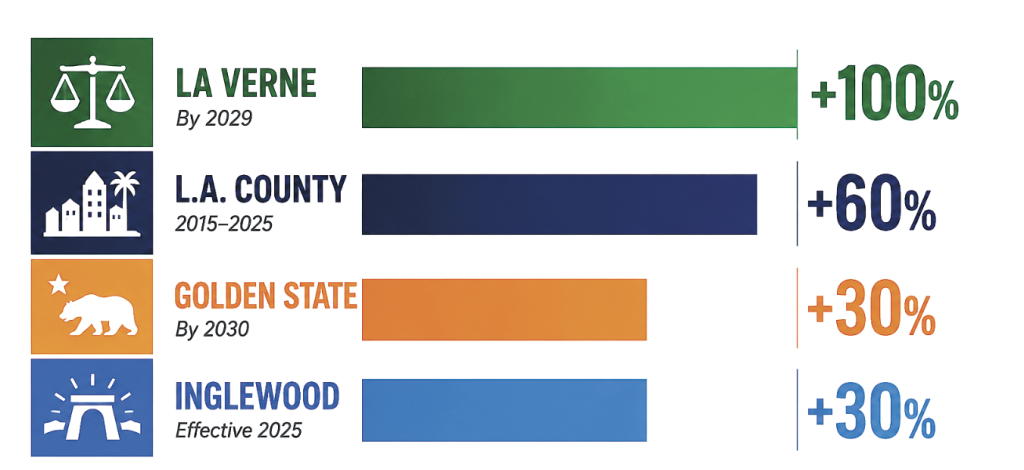
The Orange County Register recently reported that Golden State Water Co., which serves communities throughout Southern California, is proposing increases that could raise customer bills by approximately 30% by 2030, adding about $25 per month to the average bill.
Those proposed increases would come after Golden State customers were already approved for increases of 10.52% in 2025, 4.26% in 2026 and 4.07% in 2027.
Golden State says the additional revenue is needed to fund more than $180 million for infrastructure improvements, including the replacement of aging water mains, wells, storage tanks, and other equipment.
The increases are part of a much broader local trend.
According to figures cited by the Register, La Verne residents are facing an even steeper series of increases. The city adopted a 35% water-rate increase effective Jan. 1, followed by another 25% on July 1. Rates are scheduled to rise another 15% in 2027 and 10% in both 2028 and 2029.; that’s a 95% increase. City officials cited higher imported water costs, depleted reserves, and millions of dollars in planned improvements to aging pipes, wells, pumps, and reservoirs.
The average household water bill in Los Angeles County increased nearly 60% between 2015 and 2025; Inglewood recently approved increases totaling approximately 30%.
Behind the rising bills are many of the same problems confronting water agencies across Southern California: higher costs for imported water, aging pipes and infrastructure, increased operating expenses and expensive new water-quality requirements.
Southern California remains heavily dependent on imported water, and agencies must pay not only for the water itself but also for the massive systems necessary to transport, store and treat it.
Utilities are simultaneously replacing infrastructure installed decades ago while confronting new treatment requirements for contaminants such as PFAS.
Cerritos faces many of those same pressures.
Under the city’s new five-year rate structure, the largest increase occurs during the first year. A representative residential bi-monthly bill rises from approximately $65.11 to $114.62, an increase of roughly 76%, or $25 per month. Subsequent years see substantially smaller annual increases. Over five years the rates are increased over 200%.
The 76% Cerritos increase sounds enormous because the city was starting from an extraordinarily low base. Even after the first increase, the city’s own independent rate study found a typical Cerritos residential water bill remained below most neighboring agencies.
The increase nevertheless produced an intense political backlash and became one of the chief arguments used by proponents seeking to recall Yokoyama and Johnson.
Recall proponents have portrayed the increase as evidence of poor judgment by Cerritos officials.
The regional numbers provide another side of that debate.
Comparisons among water agencies are imperfect because utilities have different starting rates, rate structures, infrastructure needs and implementation periods. A 30% increase spread over several years is not the same as a 76% first-year increase.
But the wider trend is difficult to miss.
From investor-owned utilities to municipal water systems, Southern California residents are being asked to pay substantially more for water as agencies confront aging infrastructure and rising costs.
Cerritos residents have every reason to scrutinize their new rates and demand that City Hall justify how the additional money will be spent. But rapidly rising water rates are not unique to Cerritos.
They are becoming a Southern California problem.

Subscribe to get the latest posts sent to your email.