 ______________________________
 ____________________________


By Brian Hews
Publisher | Follow X
August 5, 2026
A review of Fair Political Practices Commission (FPPC) filings by Los Cerritos Community News has found that what had been presented as separate grassroots campaigns to recall Cerritos Mayor Lynda P. Johnson and Councilman Frank Yokoyama and overturn the city’s controversial water and sewer rate increases is part of a well-coordinated political operation involving interconnected committees, shared leadership, common vendors, tens of thousands of dollars in campaign spending, a former Cerritos Mayor and Councilman, and legal representation by a former chairman of the Fair Political Practices Commission.
At the center is Concerned Citizens of Cerritos, a political committee that functioned as the primary fundraising organization for the related political efforts. Campaign finance reports show the committee raised $26,644 during the reporting period, spent $49,372, and reported nearly $25,000 in unpaid obligations.
The committee also contributed $2,000 each to two separate political committees—one formed to repeal the city’s water and sewer rate increases and another supporting the recall of Mayor Lynda P. Johnson and Councilman Frank Aurelio Yokoyama.
Although California campaign finance law permits separate committees for different political purposes, the filings reveal extensive overlap among the organizations.
Both the Repeal Cerritos Water & Sewer Rate Hikes committee and the Recall Cerritos Council Members Johnson and Yokoyama committee list Carla Gilhuys as principal officer and Theresa “Terry” Pedace as treasurer. The committees also share the same committee email address, operate from the same Cerritos mailing address, and utilize many of the same campaign vendors.
Both committees also received identical $2,000 contributions from Concerned Citizens of Cerritos, according to the FPPC filings. The reports further show both committees received in-kind copying support from former Cerritos Mayor Grace Hu and made payments to Mars Printing for campaign materials.
The filings also identify the campaign’s principal financial supporters.
The largest contributors to Concerned Citizens of Cerritos each donated more than they would have paid under the City’s controversial water and sewer rate increases they are seeking to overturn.
Cerritos residents Wendy Shavelle and Robert Shavelle, each contributed $5,000. Ngan Lam Nass donated $3,000, while Ben Ao and former Cerritos Mayor Grace Hu each contributed $1,000. Additional contributions came from Gilhuys, Dixie Cahill, John Taylor and numerous other supporters including former ABCUSD Trustee Brad Beach, who shows his address on the FPPC Campaign reports in South Carolina.
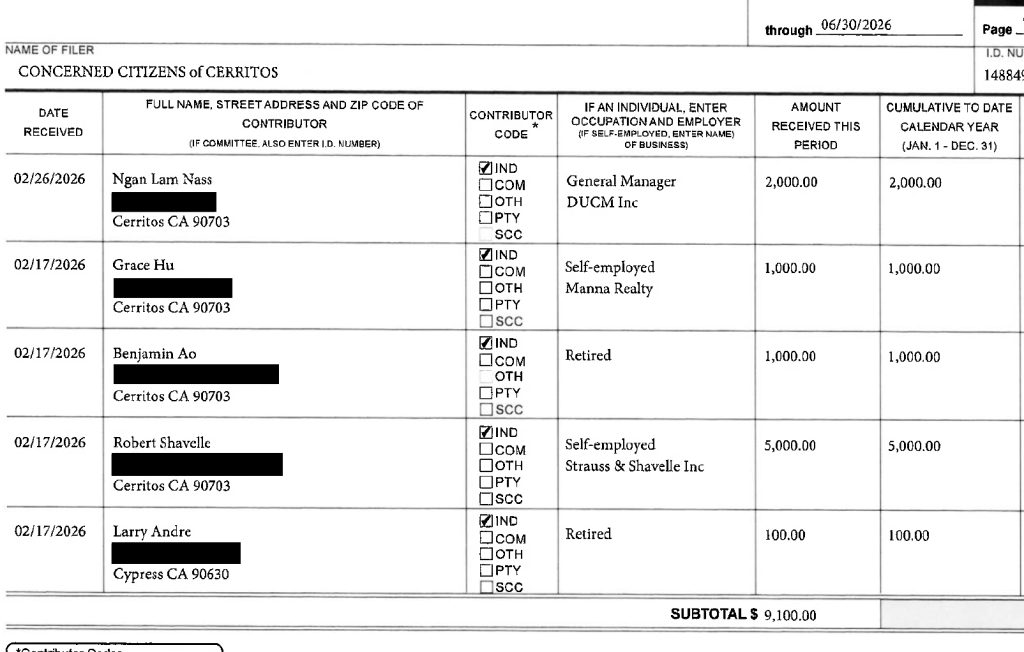
Report showing the largest donors.
_________________
Perhaps the most notable expenditure was the committee’s decision to retain Capitol Advocates, a Sacramento-based government affairs and law firm headed by Ravi Mehta, former chairman of the California Fair Political Practices Commission.
California Secretary of State business filings show an unusual history for Mehta’s company, Capitol Advocates.
State records indicate an earlier Capitol Advocates entity fell into delinquency in July 2017, received a penalty certification in November 2017, was listed as pending suspension in March 2018, and was terminated one month later, on April 30, 2018.
A new Capitol Advocates entity was later formed on Sept. 5, 2022 but Mehta waited to file the required Statements of Information until Jan. 25, 2025, and again on June 21, 2025.
The filings suggest the current Capitol Advocates is not simply a continuation of an uninterrupted business operation, but a newer entity created several years after the earlier company was terminated following delinquency and suspension proceedings.
The records also show the current business entity is registered as “Capitol Advocates-A Professional Law Corporation.” However, the firm’s website markets the practice simply as “Capitol Advocates,” with no reference to the law corporation in its branding.
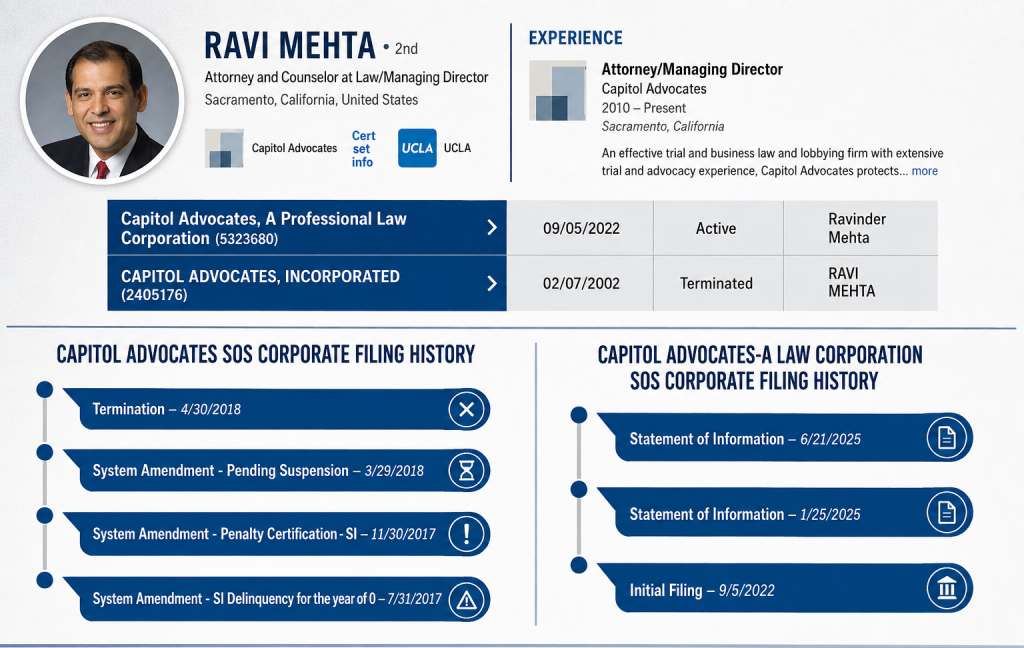
Corporate timeline of Capitol Advocates founder Ravi Mehta showing the transition from the original Capitol Advocates, Incorporated—which was terminated in 2018 following delinquency, penalty certification and pending suspension filings—to the formation of Capitol Advocates, A Professional Law Corporation in 2022. Sources: California Secretary of State business records, LinkedIn, and public records compiled by Los Cerritos Community News.
___________________
Campaign filings show a eye-popping $19,600 paid to Capitol Advocates during the reporting period for legal retainers, campaign consulting and related services. The reports also disclose additional unpaid obligations to the firm, bringing the committee’s reported legal and consulting commitments to more than $26,000.
Mehta is a well-known figure in California political and regulatory circles. In addition to serving as chairman of the FPPC—the state agency responsible for administering and enforcing campaign finance laws—his firm specializes in government affairs, campaign compliance, regulatory matters and representation before state and local government agencies.
The filings indicate the campaign retained experienced legal and political counsel early in the effort, suggesting organizers anticipated a complicated political and legal campaign extending well beyond neighborhood petition drives.
__________________
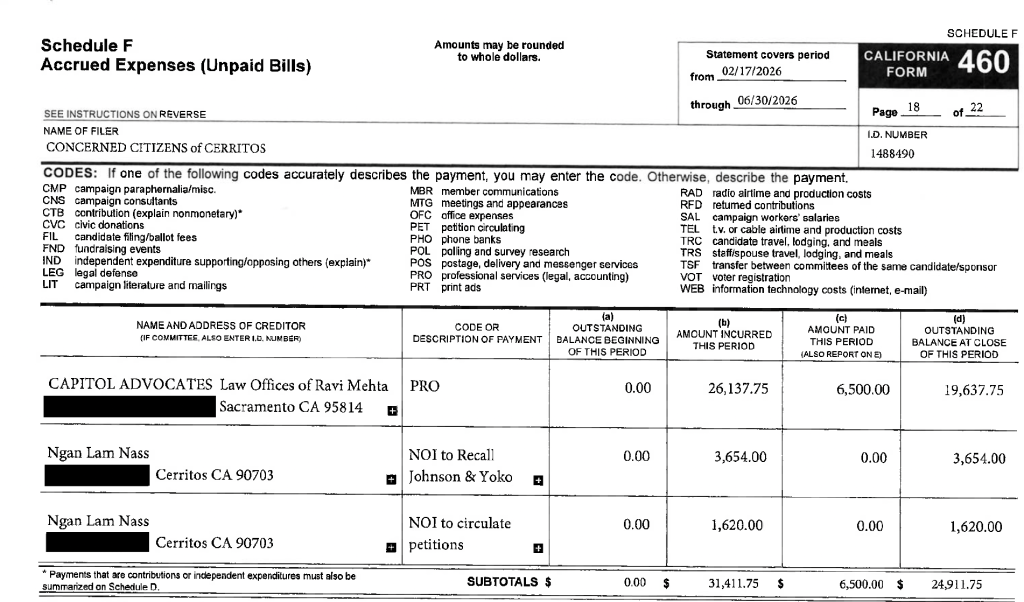
Campaign report showing financial commitments and payments to Ravi Mehta . It also shows Lam Nass paying $5,274 for legal notices bringing his total given to the committee to $8,274.
___________________
The reports also document numerous campaign-related expenditures, including legal publication notices, printing costs, campaign materials, postage, office supplies and software.
The coordinated structure illustrated in the filings provides the clearest picture yet of the organization behind the political movement opposing the city’s water and sewer rate increases.
Rather than operating as independent efforts, the reports show a network of related committees sharing leadership, resources and funding while pursuing complementary political objectives.
Nothing in the FPPC filings suggests the committee structure violates California campaign finance law. Separate committees are commonly established for different political purposes, including recalls, ballot measures and general advocacy. However, the disclosures provide voters with a better understanding of how the campaign has been organized, financed and managed.
Asked to respond to the campaign finance filings, Cerritos Mayor Lynda P. Johnson told Los Cerritos Community News, “The campaign finance reports speak for themselves. My focus remains on serving the residents of Cerritos by addressing our city’s financial challenges, maintaining public safety, and continuing the work the community elected me to do. I respect the democratic process and trust voters to draw their own conclusions from the publicly available campaign finance filings.”
In a statement to Los Cerritos Community News, Cerritos Councilmember Frank Aurelio Yokoyama said, “Thank you to the City of Cerritos employees, the ABC Unified classified employees, the local Cerritos Democratic Club members, as well as Mayor Pro Tem Mark Pulido, for opposing the Cerritos councilmember recall petitions.”
While the campaign finance reports tell the story of a sophisticated and well-funded political organization, the election calendar and how proponents got there tells a different story.
Recall proponents have frequently pointed to the approximately 6,400 Proposition 218 protest forms submitted during the water-rate proceedings as evidence of broad citywide opposition. However, after completing the required review process, city officials determined that only about 4,800 protests—approximately 75 percent—were valid. Protest forms can be rejected for a variety of reasons, including duplicate submissions, ineligible property ownership, incomplete information, and questionable signatures.
The recall campaign itself now faces an even greater challenge. Under California election law, proponents must gather 7,279 valid signatures to qualify the recall of Mayor Lynda P. Johnson and another 7,279 valid signatures to qualify the recall of Councilmember Frank Aurelio Yokoyama, for a combined total of 14,558 valid signatures across two separate recall petitions. Each petition must independently meet the required signature threshold before it can qualify for the ballot.
Experienced petition campaigns rarely stop at the minimum number of required signatures. Because some signatures are always disqualified during the verification process, campaign consultants often recommend collecting at least 10 percent more than required. For the Cerritos recall, that would mean a practical target of about 8,007 signatures for each petition—roughly 16,014 signatures combined.
And the proponents only turned in 4,800 Prop. 218 protests.
And it gets more difficult. Despite raising more than $26,000, spending nearly $50,000, retaining Mehta’s law firms, and organizing three interconnected political committees, the campaign has yet to file recall petitions with the Cerritos City Clerk’s Office.
According to a July 13 memorandum from City Clerk and Elections Official Cynthia Nava, no recall petitions had been filed as of that date. Though proponents have until Aug. 27 to submit signatures, the procedural timeline makes placement on the Nov. 3 ballot very unlikely. If the recalls ultimately qualify after that deadline, the city could instead face a stand-alone special election that officials have previously estimated could cost nearly $1.5 million.
________________
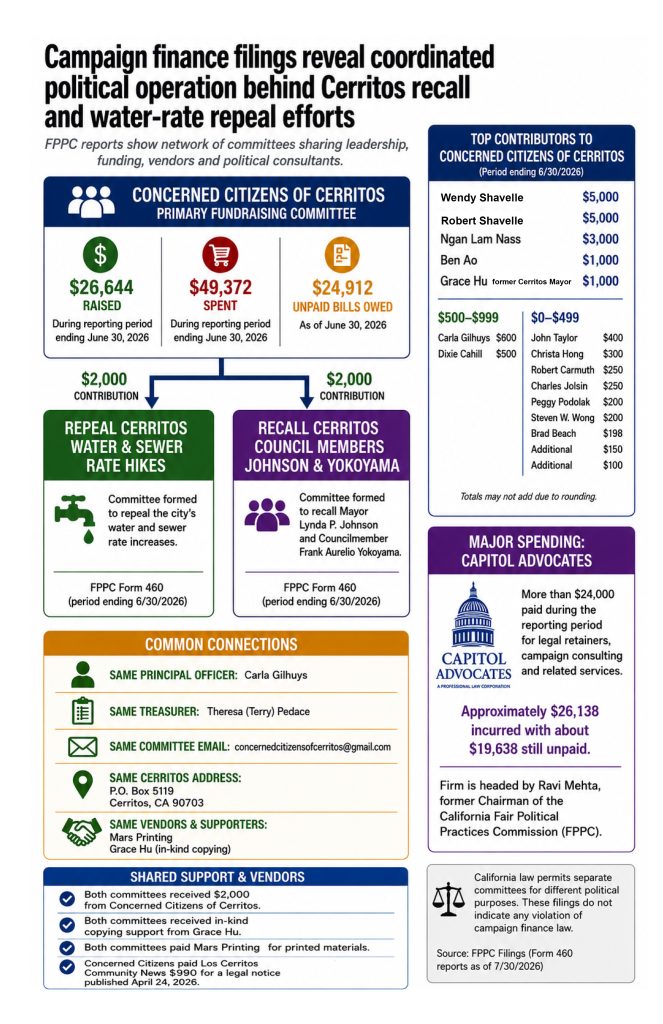
How the committees are connected. FPPC campaign finance reports show the financial and organizational relationships among Concerned Citizens of Cerritos, the recall committee, and the committee seeking to repeal the city’s water and sewer rate increases. Source: FPPC Forms 410 and 460.
See the campaign filing, click here.

Subscribe to get the latest posts sent to your email.

4 Responses to Cerritos Recall Campaign Tied to Coordinated Political Operation, Campaign Finance Filings Show