 ______________________________
 ____________________________

By Brian Hews
Publisher | Follow X
July 23, 2026
The effort to recall Cerritos Mayor Lynda P. Johnson and Counilman Frank Aurelio Yokoyama appears to be running out of time after the Cerritos City Clerk’s Office confirmed that recall proponents have not submitted any petition signatures for verification, placing the campaign’s chances of reaching the November 3 ballot in serious doubt.
If the recall fails to qualify for the November 3 ballot but ultimately gathers enough valid signatures to force an election later, Cerritos taxpayers could face the cost of a stand-alone special election. City officials have previously estimated such an election could cost nearly $1.5 million.
_______________________
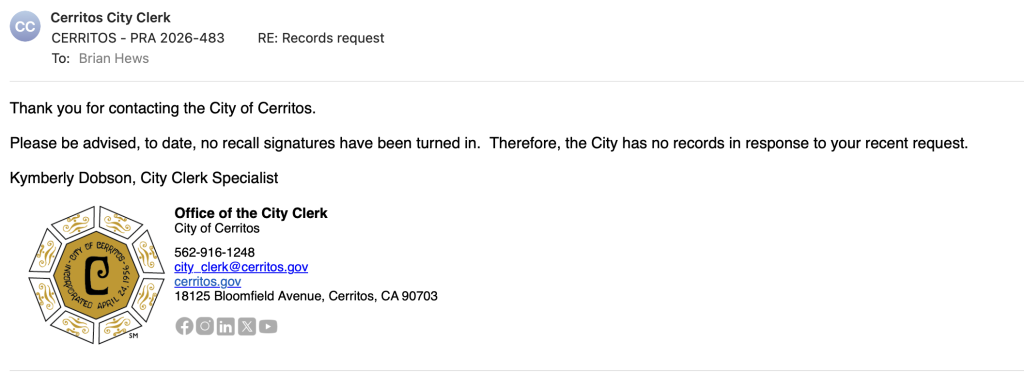
In response to an LCCN Public Records Act request, the Cerritos City Clerk’s Office confirmed on July 20 that no recall petition signatures had been submitted as of July 20, leaving little time for the effort to qualify for the November ballot. Click on image to enlarge.
___________________
The recall was launched following the City Council’s controversial approval of multi-year water and sewer rate increases. Although approximately 6,400 Proposition 218 protest forms were initially submitted, only about 4,800 were ultimately validated—representing less than one-third of Cerritos’ eligible households. The opposition nevertheless evolved into an organized campaign seeking to remove two of the city’s highest-ranking elected officials.
Recall organizers must collect 7,279 valid signatures to qualify the recall of Mayor Lynda P. Johnson and another 7,279 valid signatures to qualify the recall of Councilman Frank Aurelio Yokoyama. Although many residents may sign both petitions, each recall must independently meet the 7,279-signature threshold before it can qualify for the ballot.
Earlier this year, recall petitions began circulating throughout the city, with signed petition pages published in Los Cerritos Community News as supporters sought to build momentum.
Today, however, the campaign faces a far greater obstacle than collecting signatures—the calendar.
According to the Cerritos City Clerk’s Office, recall proponents have not submitted any petition signatures to the Los Angeles County Registrar-Recorder for verification. Without submitted petitions, the verification process cannot begin.
The calendar now presents the campaign’s biggest challenge.
The Cerritos City Council’s last regularly scheduled meeting before the Aug. 7 deadline to consolidate an election with the Nov. 3 statewide ballot is July 27. Before a recall election can be placed on the ballot, election officials must certify that enough valid signatures have been collected. The City Council must then adopt a resolution at a public meeting calling the recall election.
With no petitions yet submitted, election officials have not begun the verification process, which can take up to 30 business days, excluding weekends and holidays. That leaves virtually no time for certification and council action before the statutory deadline to place the recall on the November ballot.
Recall proponents still have until Aug. 27—the end of the 120-day petition circulation period—to submit signatures. However, waiting until that deadline would effectively eliminate any realistic opportunity for the recall to appear on the Nov. 3 ballot. If the recall ultimately qualifies after November’s regular election, Cerritos taxpayers could instead face the cost of a stand-alone special election. City officials have previously estimated such an election could cost nearly $2 million.
Los Cerritos Community News emailed the recall proponents asking whether the petitions had been submitted for signature verification. As of press time, no response had been received.
The timing is especially notable given the resources already invested in the campaign. According to Los Cerritos Community News billing records, recall proponents spent more than $5,000 on legally required publication notices in the newspaper. The campaign also incurred expenses for printing petitions and campaign materials, organizing meetings, and, according to sources familiar with the effort, retained an attorney to assist with the recall process. In addition, volunteers devoted countless hours gathering signatures and promoting the campaign throughout Cerritos.
The recall petitions accuse Yokoyama and Johnson of approving the multi-year water and sewer rate increases despite widespread public opposition. Organizers also criticized what they described as questionable spending priorities while residents were being asked to absorb higher utility costs.
The petitions further reference tensions at public meetings, including comments from the dais describing some opponents of the rate increases as “bullies,” remarks organizers contend further fueled public frustration.
City officials have consistently defended the rate increases, arguing they are vital to address decades-old infrastructure, increasing operating costs, and long-term maintenance needs. Officials have pointed to the December 2025 failure of Well C-4, which forced the city to purchase more expensive imported water, as an example of the growing cost of maintaining an aging water system.
Those concerns are not unique to Cerritos. Just last week, a major water main beneath Sunset Boulevard in West Hollywood ruptured, sending millions of gallons of water into the streets, flooding businesses, damaging vehicles, creating a sinkhole, and closing one of the region’s busiest thoroughfares. The incident illustrated the consequences cities can face when aging water infrastructure reaches the point of failure. Cerritos officials have repeatedly argued that replacing aging infrastructure before catastrophic failures occur was the primary reason for approving the controversial rate increases.
Based on Los Angeles County voter registration figures, recall organizers must collect approximately 6,400 valid signatures—about 20 percent of the city’s registered voters—to qualify the recall for the ballot. Ironically, that number closely mirrors the approximately 6,400 Proposition 218 protest forms submitted before the rate increases were approved.
If enough valid signatures are eventually verified, the City Council would be required to call a recall election, allowing voters to decide whether Johnson and Yokoyama should remain in office.
For now, however, after months of organizing, more than $5,000 in legally required publication costs, additional campaign expenses, legal assistance, extensive volunteer effort, and a highly visible signature drive, the recall’s greatest obstacle may no longer be public support.
It may simply be the calendar.

Subscribe to get the latest posts sent to your email.