______________________________
 ____________________________


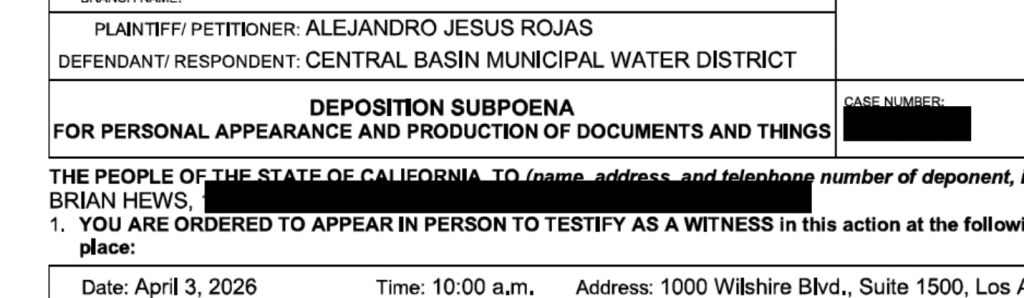
Subpoena served on Los Cerritos Community News Publisher Brian Hews in March sought years of emails, text messages and other communications with Central Basin Municipal Water District officials and board members. Hews retained First Amendment counsel and objected to the sweeping demands.
July 17, 2026
LCCN Staff Report
Last week’s subpoenas served on New York Times reporters triggered a national debate over press freedom. For Los Cerritos Community News, however, that debate had already become reality.
Just three months earlier, Central Basin Municipal Water District, acting through its outside attorneys, Los Angeles-based Buchalter, served LCCN Owner-Publisher Brian Hews with a sweeping subpoena. A subpoena is a legal order requiring someone to provide documents or testimony in connection with a legal proceeding. In this case, the subpoena sought years of communications with district officials and others connected to Hews’ investigative reporting, forcing the newspaper to retain private First Amendment counsel.
It should also be noted that multiple Central Basin directors have publicly stated during board meetings that Buchalter was never approved by the board related to a counter-lawsuit filed in the Rojas arbitration. Four directors have made that assertion on the record, raising additional questions about the firm’s authority to issue the subpoena on the District’s behalf.
The Justice Department subpoenas sought testimony from four New York Times journalists following reports about security concerns involving the new, Qatari-gifted Air Force One. Federal agents reportedly delivered some of the subpoenas directly to the reporters’ homes.
Press freedom organizations immediately condemned the move, warning that compelling journalists to testify sends a chilling message not only to reporters, but also to government employees and whistleblowers who provide information in the public interest.
Three months earlier, a similar knock came at Hews’ home.
“The process server came to my house around 7:30 that night,” Hews said. “I wasn’t home, but my wife was. The pounding on the door scared the hell out of her, and the server kept banging on and over. My wife did not answer. The next day, I was outside talking with our contractor when the same process server pulled up and handed me the subpoena.”
The subpoena, issued in an arbitration involving former Central Basin General Manager Dr. Alejandro Rojas, demanded Hews’ personal appearance and sought years of emails, text messages and other communications dating back to January 2020 involving Rojas, current and former Central Basin directors, district officials and others connected to the agency’s long-running political turmoil.
Several sources familiar with the matter said they believed the subpoena’s true purpose was to identify Hews’ confidential sources inside Central Basin. While the District later stated it was not seeking information related to Hews’ reporting, the first subpoena sought years of communications with current and former board members, district officials and others connected to the agency.
____________________
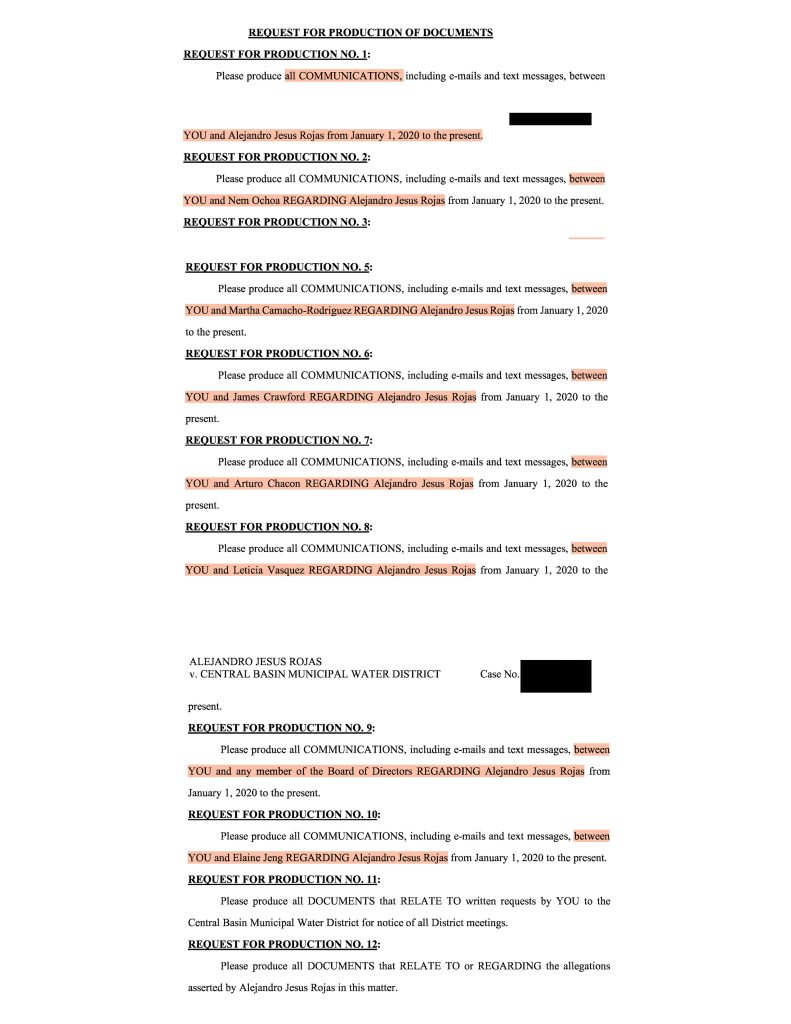
The subpoena also sought documents concerning allegations made by Rojas and records relating to Hews’ requests to receive notices of Central Basin meetings.
After reviewing the subpoena, Hews contacted the First Amendment Coalition. Legal Director David Loy immediately challenged the subpoena, arguing it was procedurally defective and violated California’s reporter shield law and the First Amendment.
Formal objections followed, asserting journalist privilege, privacy protections, attorney-client privilege, and raising concerns such as overbreadth (meaning the subpoena requested much more information than was necessary), undue burden, lack of materiality (arguing that the information requested was not important or relevant to the case), and the availability of the requested information from other sources.
Faced with that challenge, Central Basin’s attorneys significantly narrowed their position. After initially demanding years of communications and documents, they proposed a one-hour deposition limited to what they described as Hews’ “non-journalistic” interactions with the District.
That phrase was never meaningfully defined.
For a working journalist, the distinction isn’t simply blurry—it can easily become the subject of disagreement once questioning begins.
Hews and Loy rejected the proposal.
Within days, Central Basin and Buchalter informed Loy they would not withdraw the subpoena. Because the First Amendment Coalition’s representation concluded after its initial intervention, Hews had no choice but to retain private First Amendment attorney Dan Laidman of Davis Wright Tremaine LLP to continue defending the newspaper and its reporting.
Hews is no stranger to litigation involving his reporting. Years earlier, he successfully defeated a Strategic Lawsuit Against Public Participation (SLAPP) after filing an anti-SLAPP motion filed under California law. Unlike that case, however, this issue involved a subpoena rather than a lawsuit, requiring Hews to defend his reporting through California’s reporter shield law and First Amendment protections instead.
“Central Basin and its board majority had taxpayer-funded attorneys,” Hews said. “And if LCCN readers recall our previous reporting, those attorneys were never approved by the board to litigate the current Rojas matter. Meanwhile, LCCN had to reach into its own pocket.
“That is the part rarely discussed when public agencies subpoena journalists. The Constitution may protect the press, but it does not automatically reimburse a small newspaper for the thousands of dollars required to defend those protections.
“A government agency can issue an aggressive subpoena, force a publisher to hire specialized First Amendment counsel, create months of uncertainty, and then simply wait.
“Even if the journalist ultimately prevails, the legal bills remain.
“The practical effect is that a public agency, using taxpayer-funded lawyers, can force a local newspaper to spend thousands of dollars simply to defend rights the Constitution already guarantees.”
There was another troubling development.
After Hews served formal objections on March 31, Buchalter did not promptly seek an order compelling compliance. Instead, after their original subpoena had been dismantled by First Amendment attorneys, they left Hews in legal limbo while continuing to pay their lawyers with public funds.
California case law generally provides a 60-day period to seek enforcement after objections are served to certain subpoenas. Whether that deadline applies to a subpoena seeking deposition testimony constitutes a legal gray area. Hews’ attorney believes there is a strong argument that Central Basin waited too long and noted that courts have previously rejected subpoenas to reporters under similar circumstances. At this point, it is unclear whether Central Basin will attempt to revive the subpoena or allow it to lapse entirely. If the district elects to pursue enforcement, the court will need to decide whether the subpoena is still valid and whether LCCN must comply. Alternatively, if no further action is taken, the matter may quietly fade, though the basic issues of reporter protections and legal costs remain unresolved.
The subpoena may now be dead.
Or the taxpayer-funded Buchalter could still attempt to revive it, forcing LCCN to spend even more money defending against a subpoena that sought years of communications from a local newspaper.
The circumstances surrounding the New York Times and LCCN are different. One involves a federal national security investigation; the other arose from a civil arbitration involving a public water district.
But both involve government efforts to compel testimony or obtain information from journalists in connection with their reporting.
Central Basin’s subpoena ultimately produced no testimony, no documents and no confidential sources.
What it did produce were months of uncertainty, thousands of dollars in legal fees for a small independent newspaper, and a signal that, even in California, where reporter protections are among the strongest in the nation, defending a free press can still carry a steep price. Similar efforts to compel journalists’ testimony or access their confidential materials have surfaced in other states as well, showing a growing national trend that puts local newsrooms under increasing legal and financial pressure. As cases continue to emerge across the country, the difficulties encountered by LCCN illustrate broader threats to press freedom and point up the vulnerability of local journalism in the current climate.

Subscribe to get the latest posts sent to your email.