 ______________________________
 ____________________________

By Brian Hews
Publisher | Follow X
December 5, 2025
A Los Cerritos Community News investigation has found that Central Basin Water Director Juan Garza, who also serves as the Executive Director of the California Cities for Self-Reliance JPA (CCSR), operated the JPA’s contracting and communications pipeline through his private consulting infrastructure, using his Six Heron email, his personal cell phone, and his private Bellflower P.O. Box as the official points of contact for the public agency. These details appear in documents released by the JPA and obtained by LCCN.
Six Heron is a Bellflower-based strategic communications and government-relations firm operated by Garza. (In 2023, LCCN found that Garza failed to pay for a Bellflower business license from 2019 to 2023, one of those years he was Mayor of the city.)
CCSR is a Joint Powers Authority, a public agency created when two or more California cities, counties, or special districts agree to pool their powers and work together on shared goals. JPAs operate much like other government bodies, but only within the authority granted by their member agencies. Because a JPA is funded by public dollars, its operations are subject to transparency, procurement, and conflict-of-interest laws.
CCSR is comprised of four member cities with local card club operations: Bell Gardens, Commerce, Compton, and Hawaiian Gardens. Its mission is to “empower communities and leadership statewide to advocate for card rooms as vital resources to cities and local services such as police, fire, schools, and transportation.” CCSR describes its work as educating and engaging the community, lobbying, communications, and legal action.
Garza’s CCSR contract shows that he earns a monthly salary of $6,744 as Executive Director and has held the position since March 2020. In addition to serving as the public face of the JPA, Garza performs its operational, communications, agenda-setting, administrative, and regulatory-contact functions.
When presented with documents outlining the communications pipeline, Garza acknowledged that his private channels have served as the JPA’s “official contact information” since March 2020, four of those years with an unlicensed business. He stated that because the JPA had no physical office, his business address and accounts were used for official correspondence.
Documents obtained by LCCN show that vendors responding to a formal JPA request for proposals were instructed to email Garza at his Six Heron address, call his personal cell phone, and mail materials to his private P.O. Box. One company addressed its submission directly to “Juan Garza, Executive Director” at [email protected].
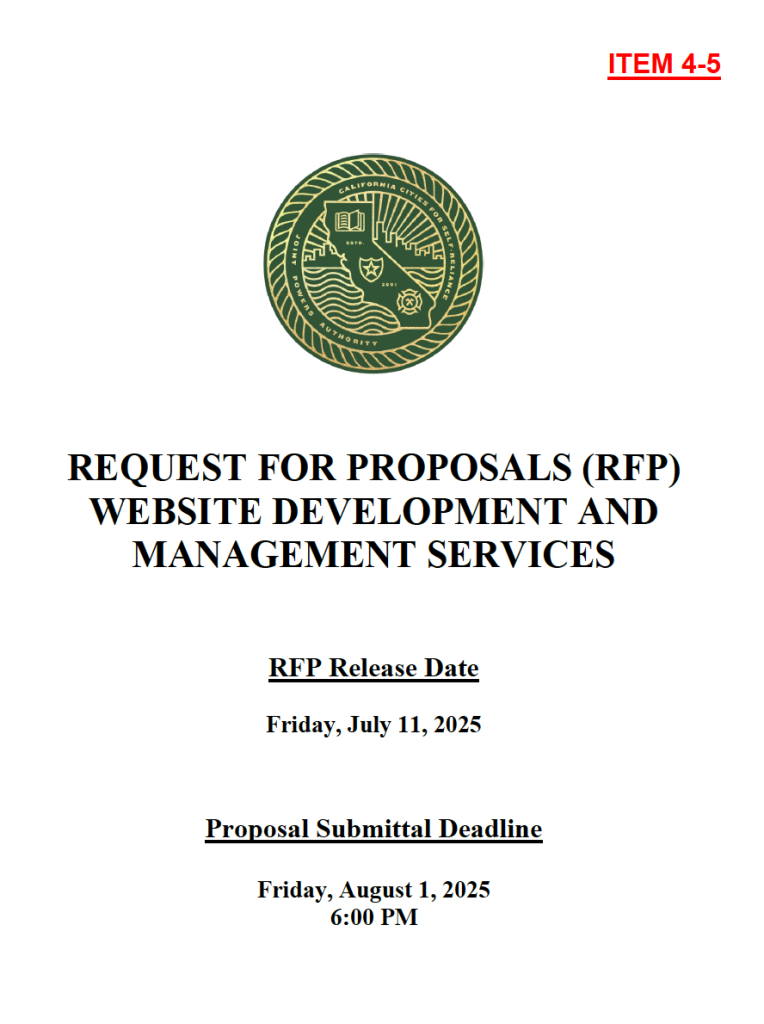
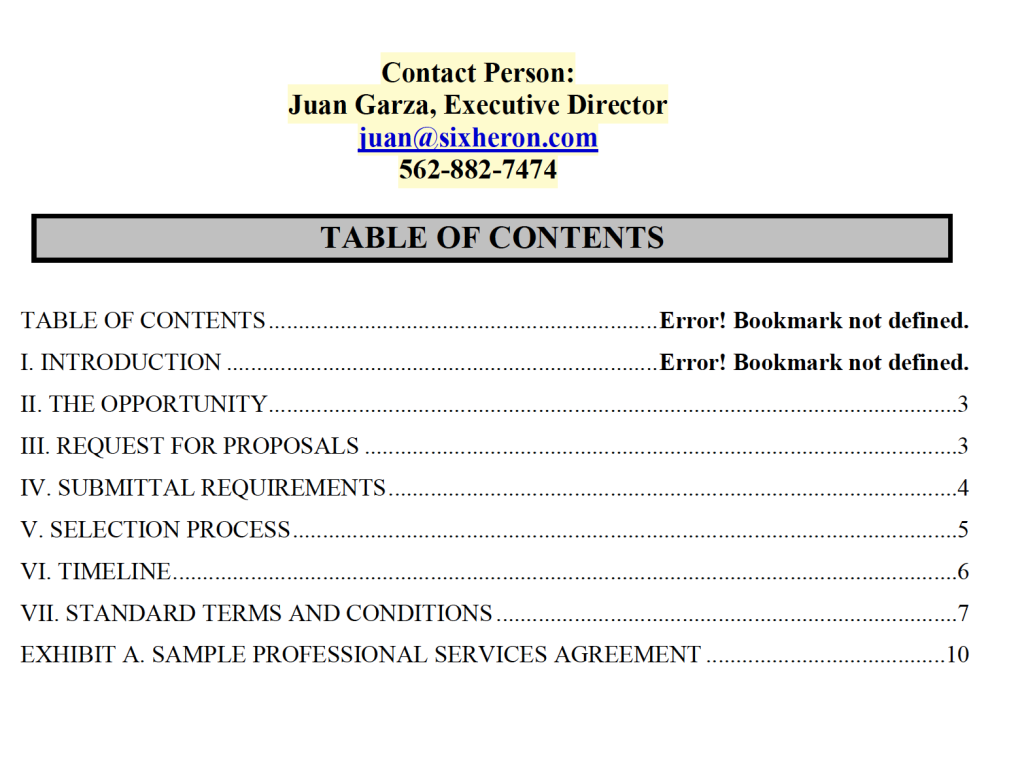
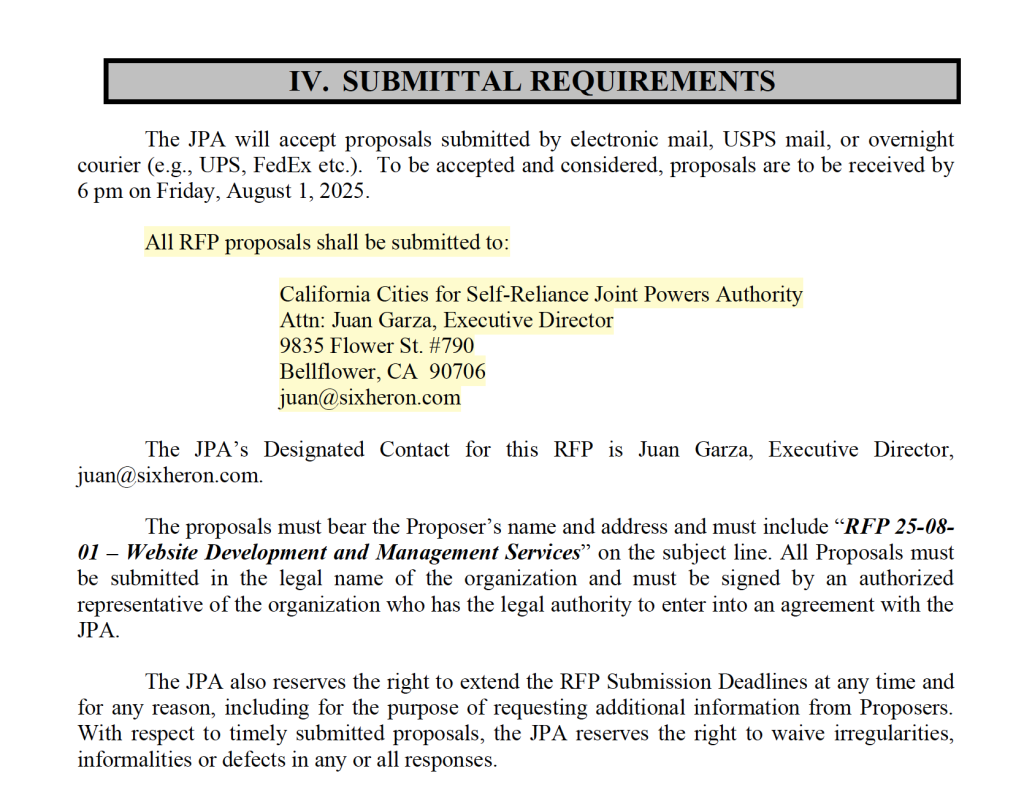
Pages from one bid sent out by Garza for the JPA showing Garza acting in multiple procurement-related roles, including bid contact, bid receiver, reviewer, and contract recommender.
As reflected in these documents, Garza functioned in multiple procurement-related roles, including bid contact, bid receiver, reviewer, and contract recommender.
In many public agencies, concentrating all of these duties in a single individual would require recusals, conflict disclosures, or procedural separation to avoid the appearance of undue influence. In this case, the JPA’s records show that the process remained consolidated under Garza, removing checks typically applied to public contracting.
In his statement to LCCN, Garza said he evaluated proposals with the JPA’s general counsel before presenting them to the board. “All bids were shared with the board and general counsel… and evaluated by myself and the General Counsel,” he wrote. That is true, but the bids were shared after receipt and evaluation.
No documents provided to LCCN indicate that the JPA used an independent procurement officer, a dedicated agency-controlled email system, or any internal separation between Garza’s public duties and his private business infrastructure.
Garza maintained that the private contact points were “means of communication exclusively” and did not represent a conflict. However, the email address belongs to his private consulting company, the P.O. Box is the mailing address he lists on his contract for Six Heron, and the cell phone number is his personal line.
Garza has frequently highlighted his experience on public boards and his knowledge of governance and procurement rules. That background is relevant because it shows that Garza understood standard procurement safeguards.
In addition, Garza previously criticized procurement processes at the Central Basin Water District, including the process overseen by former General Manager Dr. Alex Rojas, even though Dr. Rojas became involved only after the contracts had already been scored and ready for award.
California public-agency regulations require procurement communications to occur through agency-controlled channels and prohibit routing public contracting processes through private business infrastructure. Under Garza’s arrangement, decisions about what information was forwarded to the board—and when—were made solely by him.
Yes they were — and in some cases, no one on the JPA board even knew these arrangements existed. In October 2023, an LCCN investigation revealed that Garza had been awarding lucrative CCSR contracts without issuing Requests for Proposals, the most basic safeguard in public-sector procurement. At least one board member told LCCN they had no knowledge Garza was handing out these no-bid deals.
LCCN confirmed that Garza failed to put the JPA’s lobbying contract out to bid for at least two years, despite its value: $80,000 annually, drawn from CCSR’s modest $235,000 operating budget. The contract went to California Advocacy, LLC — a Sacramento firm owned by Marvin Pineda, a close associate of Garza’s — further underscoring how the JPA’s financial decisions were being controlled and directed through Garza’s personal network rather than through any transparent, competitive public process.

COMPLETE CONTROL: With complete control of the bidding/award process, Garza never sent out an RFP for the lobbying firm run by his good friend, Marvin Pineda, center, for over two years. The contract was for $80,000, at the time 34% of CCSR’s operating budget.
_______________
Under Government Code § 6509, JPAs must follow the same procurement, contracting, and transparency requirements that apply to their member agencies or the agency designated in their joint-powers agreement. These requirements include competitive bidding, the use of agency-controlled communication channels, and clear separation between public duties and private business interests.
Employment Contract Conflict
Garza’s employment contract with CCSR raises additional governance questions. Approved publicly in January 2024, it identifies his official Executive Director contact address as the same private Bellflower P.O. Box associated with his consulting business, giving him exclusive control over official inbound and outbound mail.
The contract states that Garza “will have no conflicts of interest” that could interfere with his duties, even though the physical and digital points of contact used for JPA business belonged to his private company, which also engages in lobbying and political-influence work.
The agreement grants Garza broad authority over operations, agenda development, staffing, and administrative decisions. As a result, the JPA effectively routed its governance infrastructure through a single individual using private business systems.
Garza told LCCN that the arrangement caused “no challenges nor issues” and that the board’s receipt of packet materials constituted disclosure. Legally, however, passive inclusion in an agenda packet does not satisfy disclosure requirements under California conflict-of-interest statutes or procurement standards.
What Garza has built is not a governance structure — it is a closed loop of self-dealing. His Executive Director contract for the California Cities for Self-Reliance JPA gives him full control over the agency’s operations, and instead of carrying out those duties through public systems, he funneled the entire JPA through his private firm, Six Heron.
Every contract, every communication channel, every point of public contact was routed into infrastructure he personally owns. That means the public official who is supposed to be protecting taxpayer interests is the same person whose private business stands to gain from keeping the JPA dependent on him.
In effect, Garza turned a government agency into a personal enterprise, overseeing himself, directing himself, and benefiting from decisions he made in a public seat he was never supposed to exploit.
The situation raises concerns about transparency, compliance, and whether member cities were aware that their JPA was functioning through private commercial channels instead of its own administrative systems.
The JPA represents the cardroom cities of Bell Gardens, Commerce, Compton, and Hawaiian Gardens, but nothing in the record shows that any of those cities — or the licensed cardrooms that fund the JPA — directed, approved, or even knew about the system Garza put in place.
The documents make it plain: Garza alone established and controlled the JPA’s communications and procurement pipeline. His own statements confirm that for more than four years, the agency’s operations were conducted entirely through the email, phone number, and mailing address of his private business.
As Executive Director, Garza is responsible for advancing the interests of the four card-club cities in Sacramento — a role that places him at the center of high-stakes lobbying, legislative monitoring, and regulatory engagement that directly affects millions of dollars in annual card-room revenue.
Yet instead of presenting the JPA as the public agency it is, Garza positioned his private company, Six Heron, as the face and funnel of that advocacy work. Legislators, lobbyists, state agencies, and industry groups interacting with the JPA were routed through a Bellflower P.O. Box, a private cell number, and a Six Heron email account, none of which belonged to the JPA or to any member city.
The effect is profound: for over five years, Sacramento’s policy apparatus understood the JPA’s point of contact to be a private firm owned by the very person hired to represent the cities’ collective interests. That meant all legislative intelligence, stakeholder communication, and vendor outreach flowed first to Garza’s business, not to a public office — giving Six Heron functional control over how the JPA’s message was delivered, and how information coming back from Sacramento was filtered, prioritized, or withheld.
Questions submitted by LCCN to CCSR’s Board of Directors went unanswered.
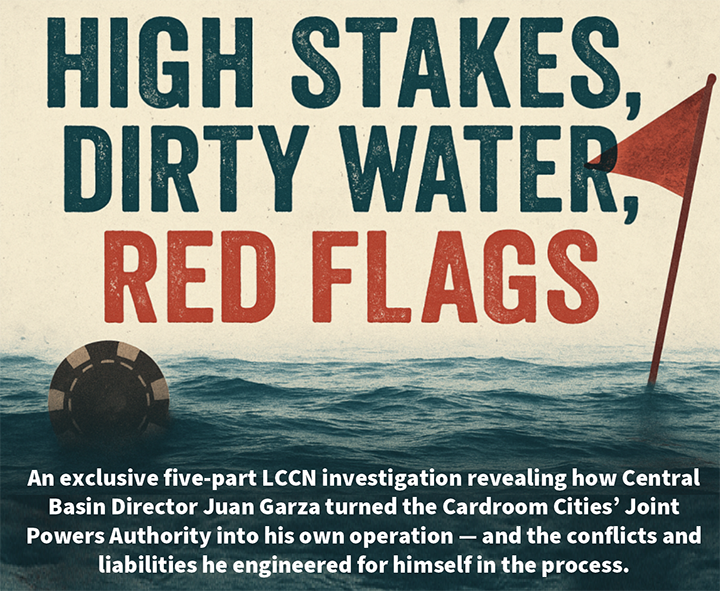
This first installment of High Stakes, Dirty Water and Red Flags details how the JPA became a one-man operation under Garza’s control. The next installment will examine how Garza’s private control of the JPA creates conflicts with his elected position on the Central Basin Water Board.

Subscribe to get the latest posts sent to your email.